

A $29 subscription, a $0.07-per-second API, and a 20-video allowance describe three different purchases. The useful comparison is the bill for the work you need to finish.
For twenty one-minute standard lip-sync outputs in a month, FreeLipSync Starter costs $9.90. Our current-rate illustrations put HeyGen Avatar IV Photo at $29, Synthesia Starter scripted-avatar video at an estimated $29, and OmniHuman 2.0 at $84. These are different workflows with different capabilities, not matched-quality or matched-resolution results.
This Q4 edition checks public official sources on October 15, 2026, UTC. It carries forward the three-part calculation method from our second-half pricing report: published rates, maximum-efficiency subscription costs, and practical workload costs. It adds whole-month spending and volume charts so a cheap-looking unit rate does not hide a larger bill.
Disclosure: this report is published by FreeLipSync. We have not run an independent quality benchmark. Prices are USD before tax, with no promotional discounts, negotiated terms, carried credits, or free-trial balances in the paid comparisons. Your account's checkout and generation estimate take precedence.
The Q4 changes worth checking
- FreeLipSync's current Starter price is $9.90/month. Do not carry the older $4.99 figure into a new budget.
- HeyGen's current credit documentation separates Avatar IV Photo, Avatar IV Video, and Avatar V. The older shared 20-credits-per-minute assumption is no longer the standard public rate.
- Synthesia changed its plans on October 1: Creator became Pro, and standard video creation now combines included minutes with a shared credit pool.
- BytePlus advertises OmniHuman 2.0 at $0.07/second. Seedance 2.5's current ModelArk documentation also extends beyond the launch-era 720p pricing snapshot.
First choose the workflow
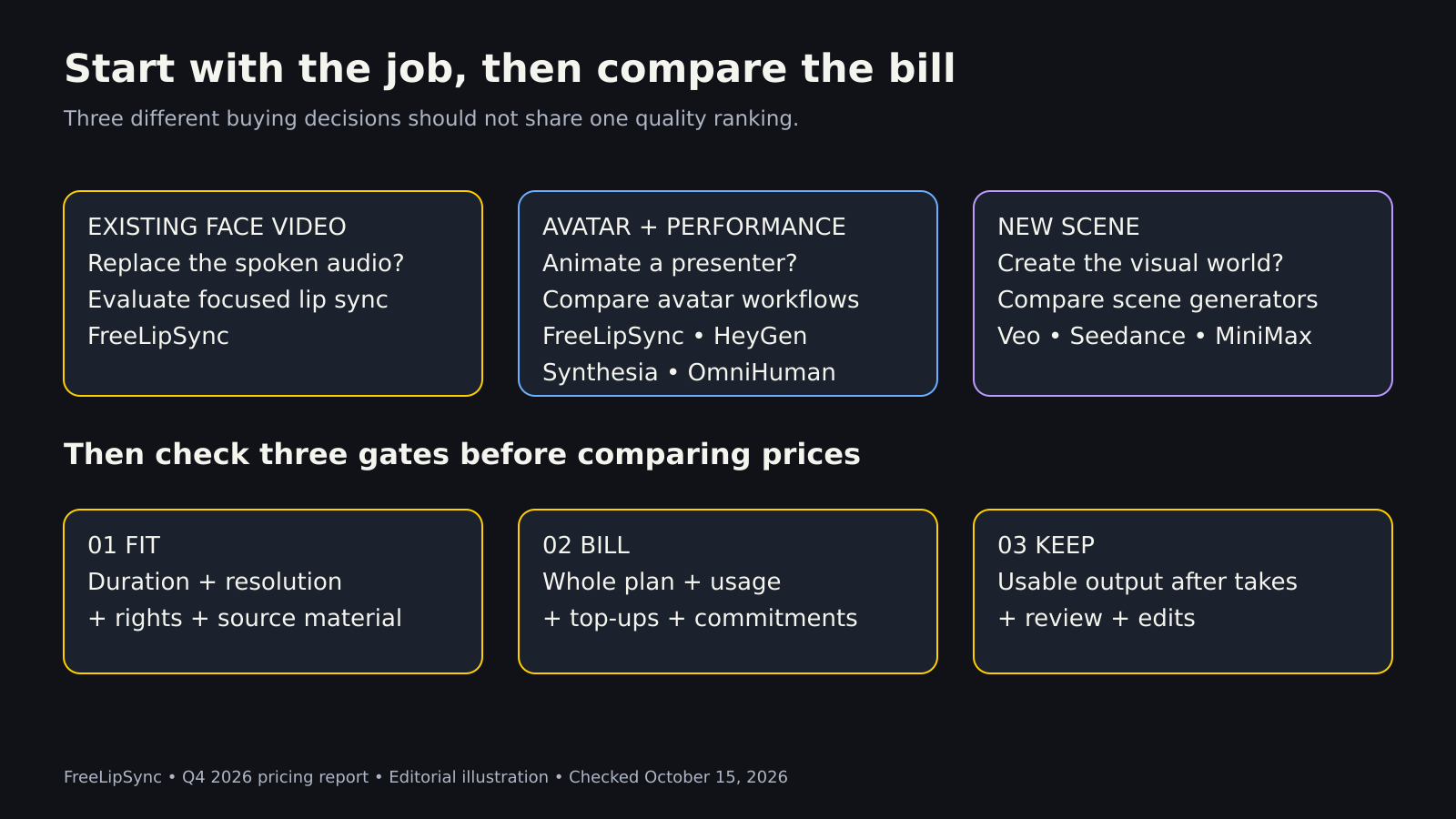
For an existing face video and a finished voice track, compare focused lip sync. FreeLipSync's audio-to-video tool replaces the spoken performance without requiring a new scene.
For a portrait-driven presenter, compare avatar workflows: FreeLipSync, HeyGen, Synthesia, and OmniHuman. Synthesia is especially relevant to scripted presenter and training videos; its self-serve plans are not an uploaded-audio lip-sync replacement. If the brief requires new scenery, cinematic camera work, or prompt-driven visual sequences, examine Veo, Seedance, and MiniMax separately. Their per-second figures provide context; they should not be treated as interchangeable substitutes for changing speech in existing footage.
This edition focuses on established avatar platforms and major AI video providers rather than repeating every creative suite in the earlier report. The main budget examples cover talking photos, lip sync, and scripted presenters; broader scene generation stays in its own section.
How the calculations work
We use four related numbers:
- Metered cost: billable seconds × the selected rate. Token-billed services require the provider's token formula instead.
- Subscription efficiency: monthly plan price ÷ output seconds supported by its included allowance. This is an allocation at full use, not an a-la-carte price.
- Workload bill: the full subscription charge plus the usage or top-ups needed for the specified jobs.
- Usable-output cost: the actual total bill ÷ the minutes you keep after review.
The reference workload is twenty 60-second outputs: a repeatable short-form publishing month, and the same practical average-length assumption used in the earlier report. It does not imply that every reader produces twenty clips. Our second chart varies volume from one to twenty. All main scenarios assume one usable generation per output, with retries examined separately.
Annual monthly equivalents are never substituted for cancellable monthly prices in the workload charts. For example, HeyGen lists Creator at $29 monthly or $24/month paid annually, equivalent to $288 per year. That annual commitment is a different buying decision. HeyGen pricing.
Twenty one-minute outputs: the whole bill
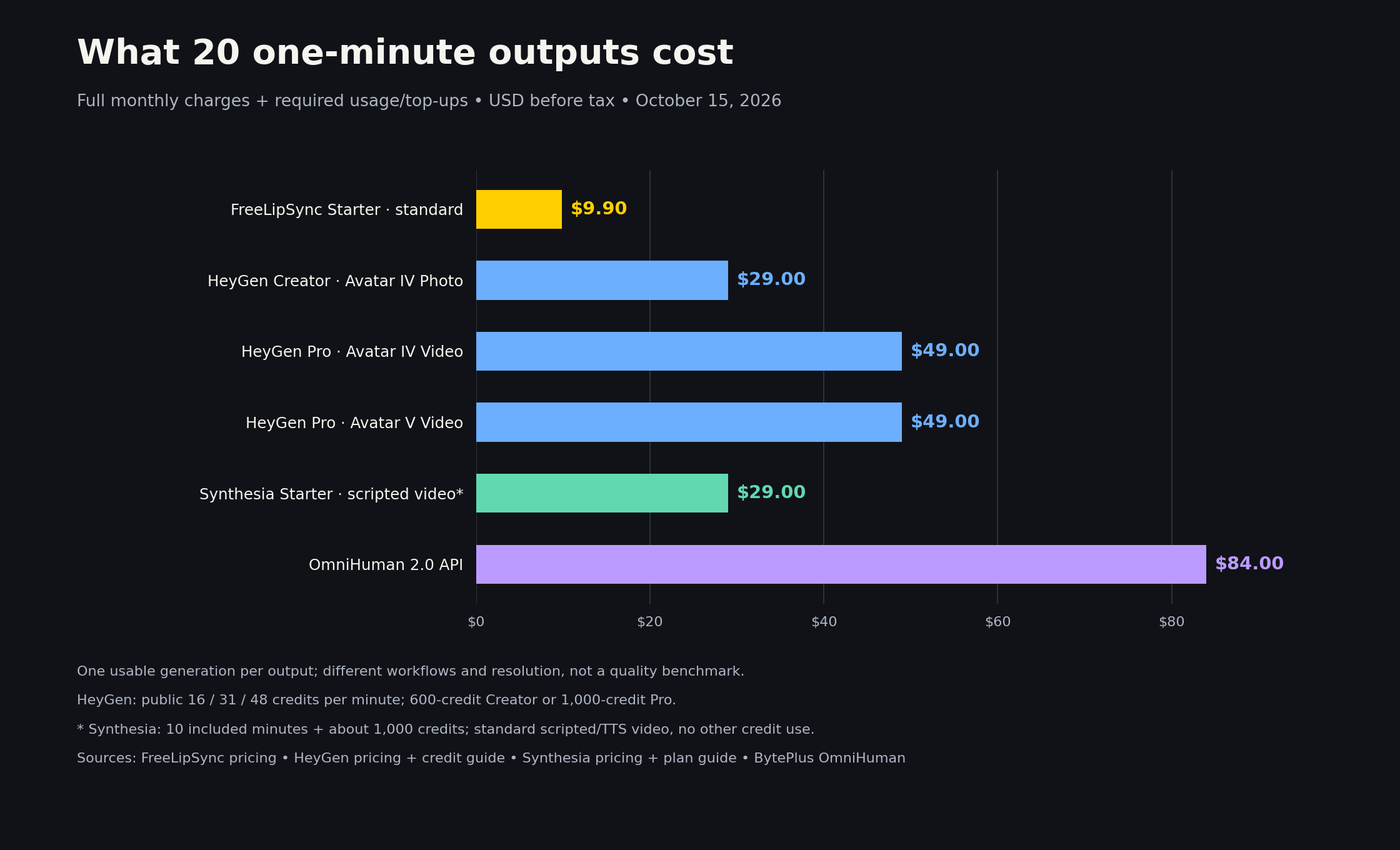
| Workflow | Required allowance or usage | Illustrative monthly spend |
|---|---|---|
| FreeLipSync Starter, standard lip sync | 20 Pro Video jobs | $9.90 |
| HeyGen Creator, Avatar IV Photo | 320 of 600 credits | $29.00 |
| HeyGen Pro, Avatar IV Video | 620 of 1,000 credits | $49.00 |
| HeyGen Pro, Avatar V Video | 960 of 1,000 credits | $49.00 |
| Synthesia Starter, scripted/TTS avatar video | 10 included minutes + about 1,000 credits for the next 10 | $29.00 estimated |
| OmniHuman 2.0 API | 1,200 seconds × $0.07 | $84.00 |
The HeyGen video-look rows exceed Creator's 600 credits, so they use the full $49 Pro subscription. The Synthesia row uses its approximate 100-credits-per-minute standard-video estimate after the ten included minutes, with no other credit use. It excludes the higher-cost Syren agent and requires no top-up in this scenario. Source-specific qualifications follow below.
FreeLipSync's $9.90 is 88.2% below $84 for this particular workload. The $74.10 difference can remain available for scripting, audio, and editing. It is a budget result, not evidence that the outputs are equivalent.
FreeLipSync: count jobs, then check duration
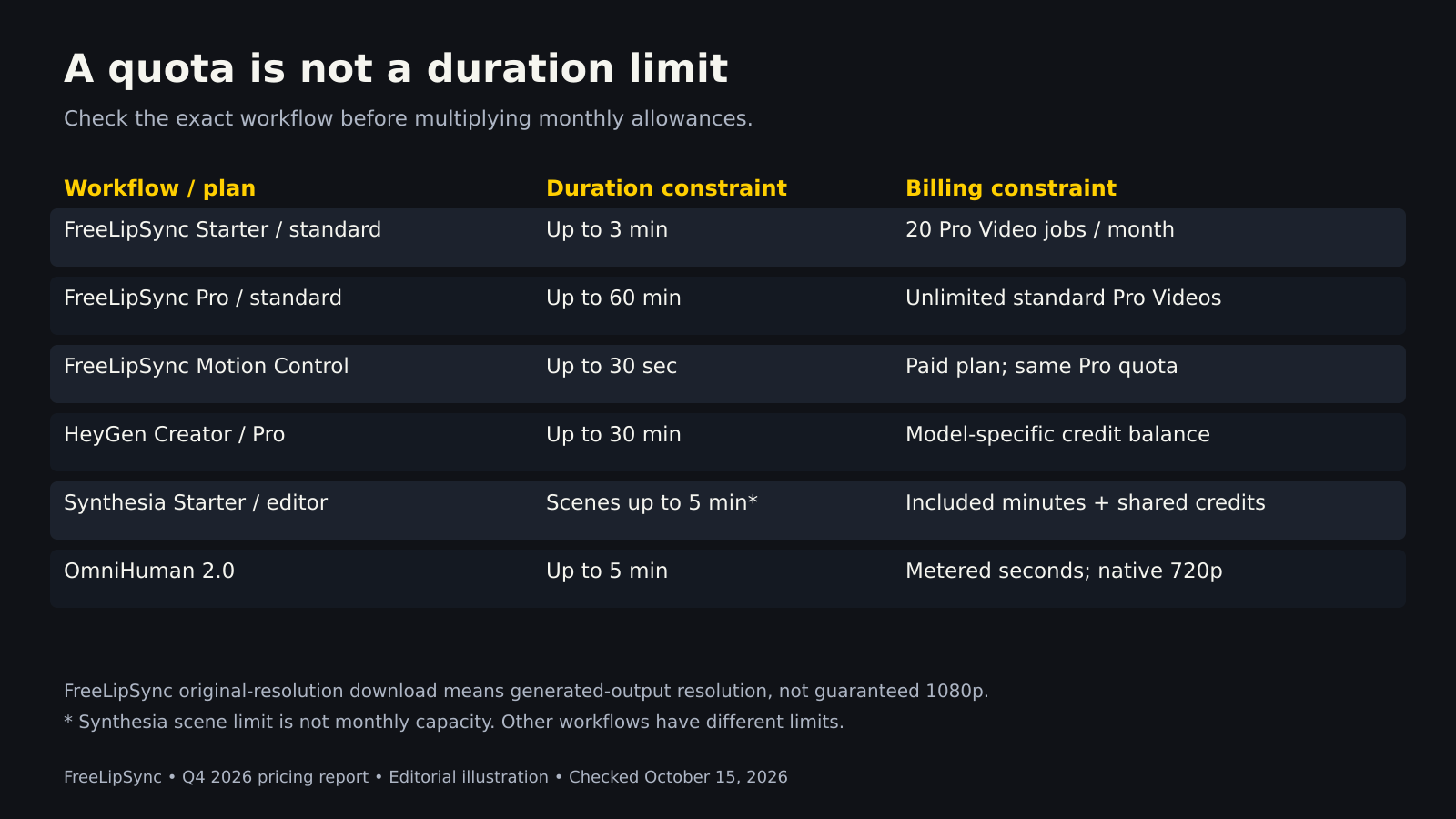
FreeLipSync pricing lists Starter at $9.90/month with 20 Pro Videos and a three-minute standard-video limit. Pro is $69.90/month with unlimited Pro Videos and a 60-minute standard limit. Each Generate Pro job uses one Pro Video allowance; duration does not multiply that charge within the workflow's limit.
For twenty Starter jobs, the effective allocation is:
| Average duration | Total output | Cost/second | Cost/minute |
|---|---|---|---|
| 30 seconds | 10 minutes | $0.01650 | $0.990 |
| 60 seconds | 20 minutes | $0.00825 | $0.495 |
| 180 seconds | 60 minutes | $0.00275 | $0.165 |
The last row is theoretical maximum use. Making only one short video still costs the full monthly fee. Twenty jobs also do not mean twenty final keepers plus unlimited extra attempts.
Paid Pro generation includes the original generated-resolution download. “Original resolution” describes the generated output; it does not guarantee 1080p or preserve the input's pixel dimensions. The FAQ explains plan and download terminology.
For a portrait and a recorded performance, audio to talking photo is a direct route. The separate Motion Control workflow uses Super, requires a paid membership, and is capped at 30 seconds and 150 effective text characters. It shares the Pro Video quota but not the standard workflow's long-form limit. Pro's separate Music Video workflow has a six-minute cap. Uploaded-audio limits should not be mistaken for text-to-speech script allowances.
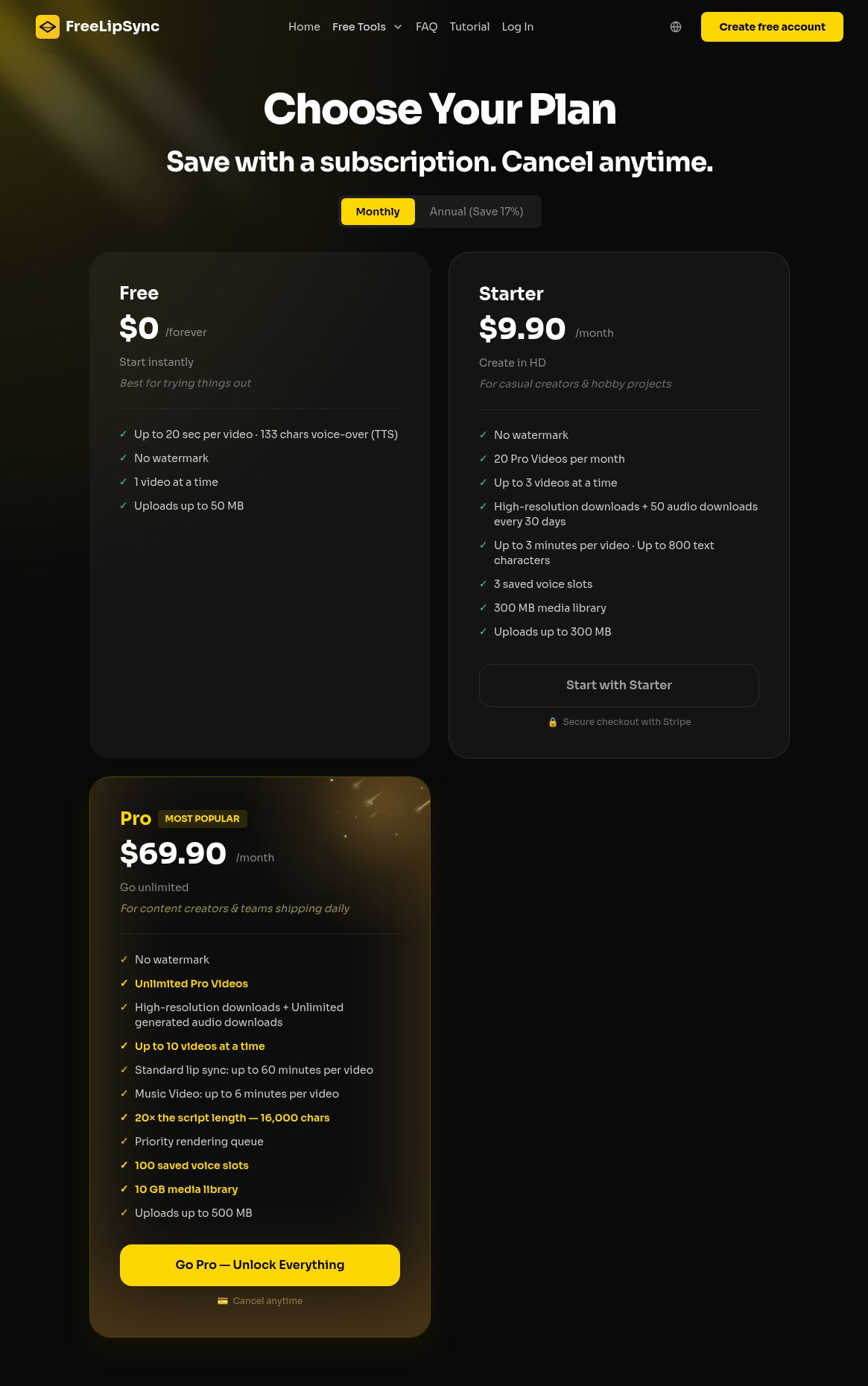
FreeLipSync official monthly pricing, captured October 15, 2026: Starter $9.90 and Pro $69.90.
HeyGen: the model and Look type change the math
HeyGen's current credit guide lists Avatar IV Photo at 16 credits/minute, Avatar IV Video at 31, and Avatar V Video at 48. With all 600 Creator credits allocated to one feature, that supports 37.5, about 19.35, or 12.5 minutes respectively.
At the $29 monthly price, the corresponding full-use allocations are roughly $0.01289, $0.02497, and $0.03867 per second. These are utilization figures, not prices for buying an isolated second. Custom Expressive Motion adds 40 credits/minute; it is not included in the base avatar calculation.
The guide warns that account-specific rates may differ. Creator and Pro obtain additional capacity through upgrades rather than one-time credit packs. Always inspect the actual generation estimate. The plan page lists up to 30-minute videos, 1080p export on Creator, and 4K export on Pro. Export resolution is not a cross-product quality benchmark.
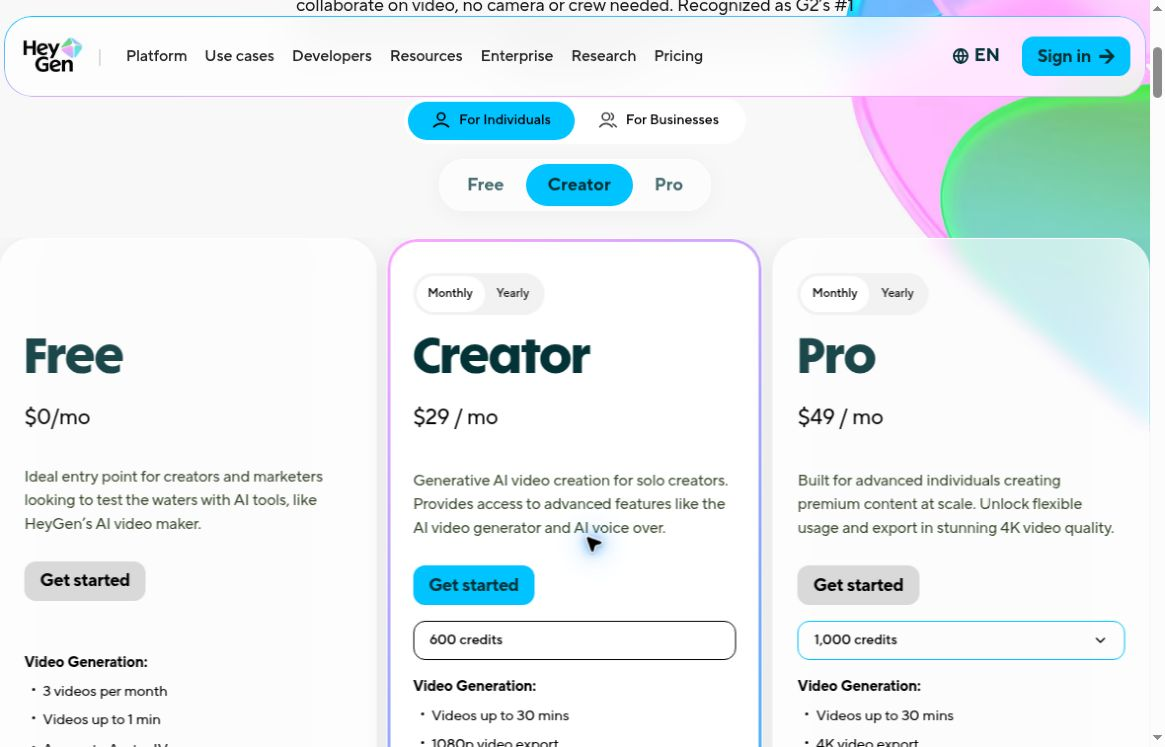
HeyGen official monthly plans, captured October 15, 2026: Creator $29 with 600 credits and Pro $49 with 1,000.
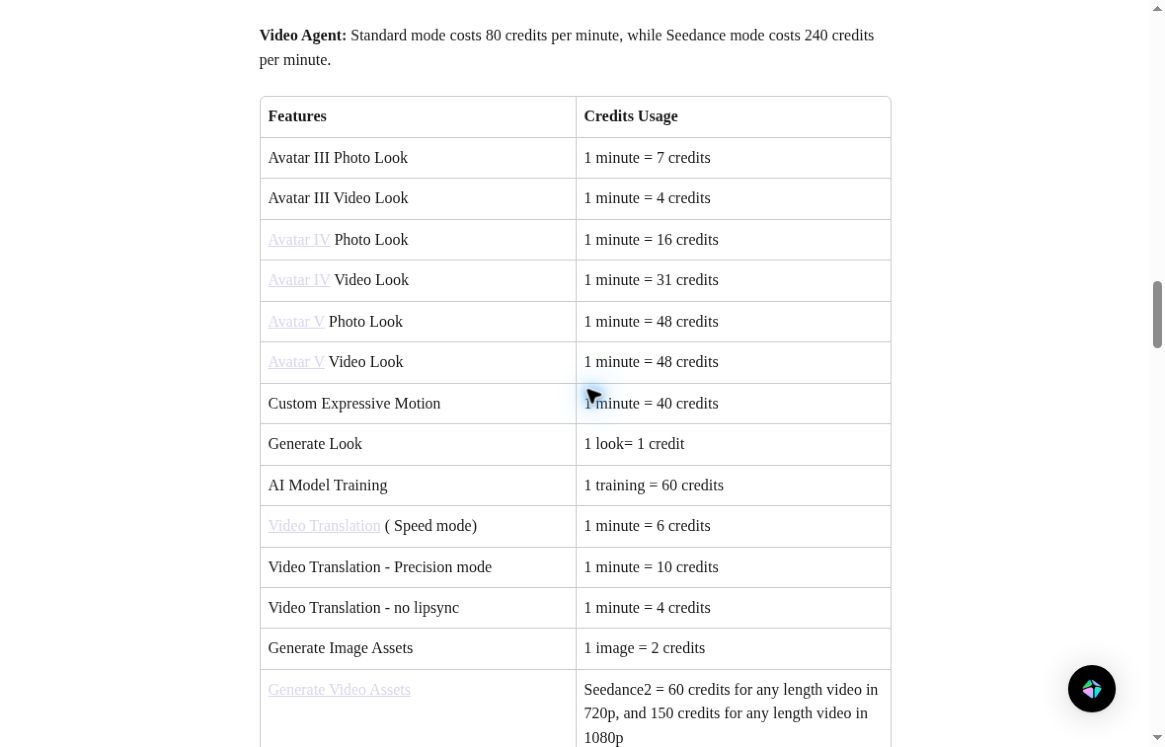
HeyGen official credit guide, captured October 15, 2026, separating Avatar IV Photo, IV Video, and Avatar V rates.
Synthesia: included minutes plus shared credits
Synthesia belongs in this comparison for scripted avatar presenters, training, and business video. Its October 1 plan update renamed Creator to Pro and changed the allowance structure. The ten recurring included video minutes are consumed first; credits apply afterward. Standard video creation is estimated at about 100 credits/minute, with actual usage depending on on-screen avatar time and other content.
The current pricing page lists Starter at $29/month and Pro from $89/month. Starter adds 1,250 paid credits above the recurring base allowance. Our twenty-minute example uses ten included minutes plus about 1,000 credits for the remaining ten, fitting Starter without relying on promotional credits. That is $1.45 per output minute in this scenario, rather than an a-la-carte minute price. Its download and logo-removal features are included. The annual Starter display is $18/month, or $216 for the year; we use the full $29 monthly option instead.
Do not transfer this estimate to every Synthesia workflow. Syren's AI-agent videos typically consume 1,000–2,000 credits per minute. Other assets and features share the balance. The script documentation restricts uploaded voiceover to Enterprise, so our Starter scenario uses a script and generated speech. Download documentation specifies Full HD output; that does not establish equivalent quality to another provider.
The editor's creation limits allow scenes up to five minutes, with longer multi-scene projects. These are project limits, not included monthly generation time. Check your generation estimate and available credits before exporting; we have not assumed a universal overage or refund policy.
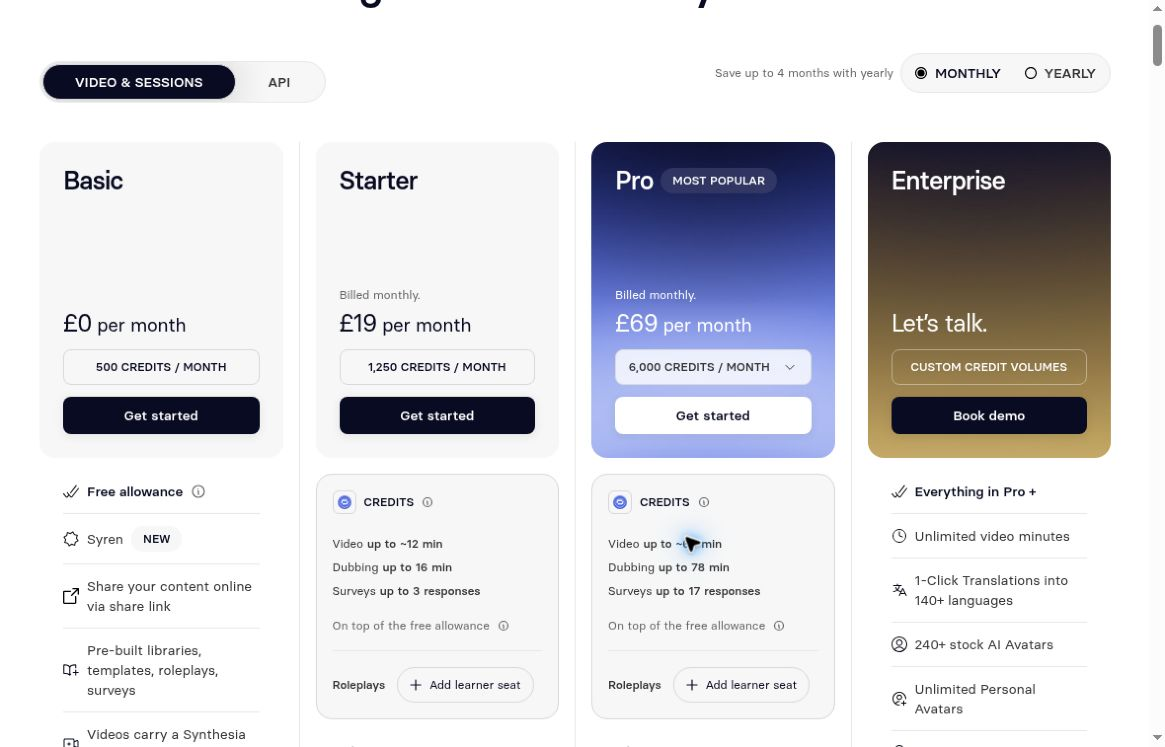
Synthesia official monthly pricing, captured October 15, 2026 in the regional GBP display: Starter £19 and Pro £69. The USD figures in this report were separately checked against official USD pricing; no currency conversion is used.
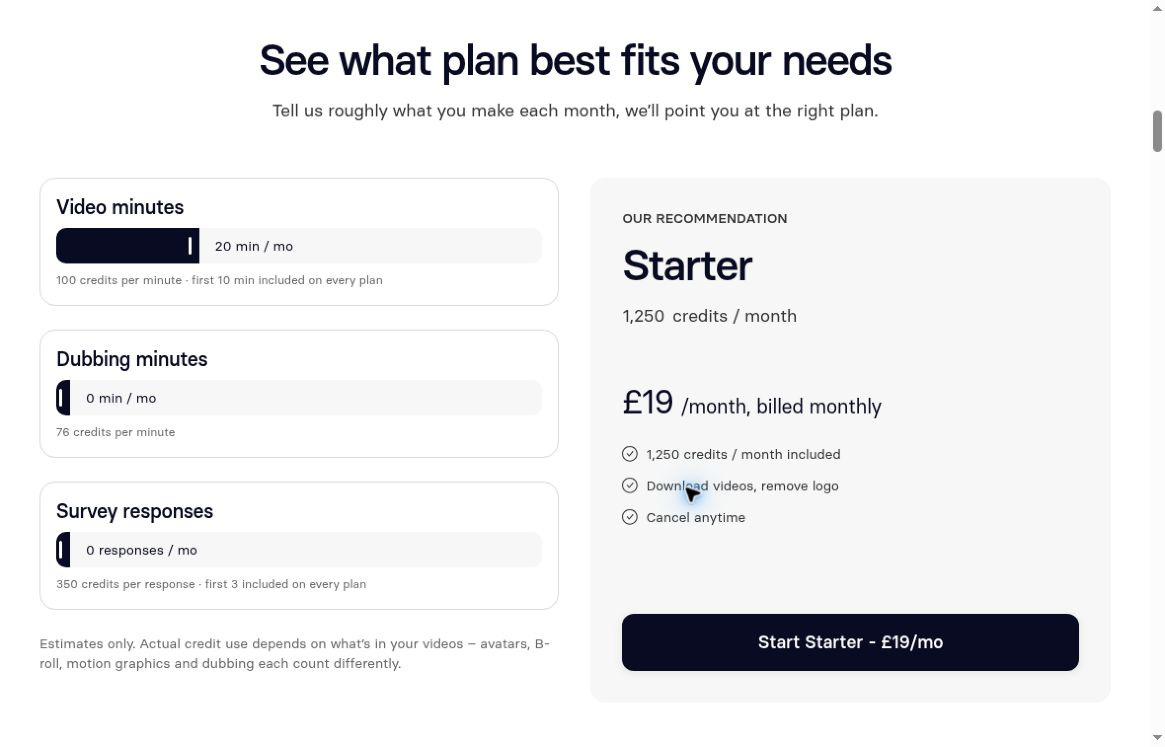
Synthesia official calculator at twenty video minutes per month, captured October 15, 2026. It recommends Starter using the first ten included minutes and an estimated 100 credits per minute afterward; regional GBP display.
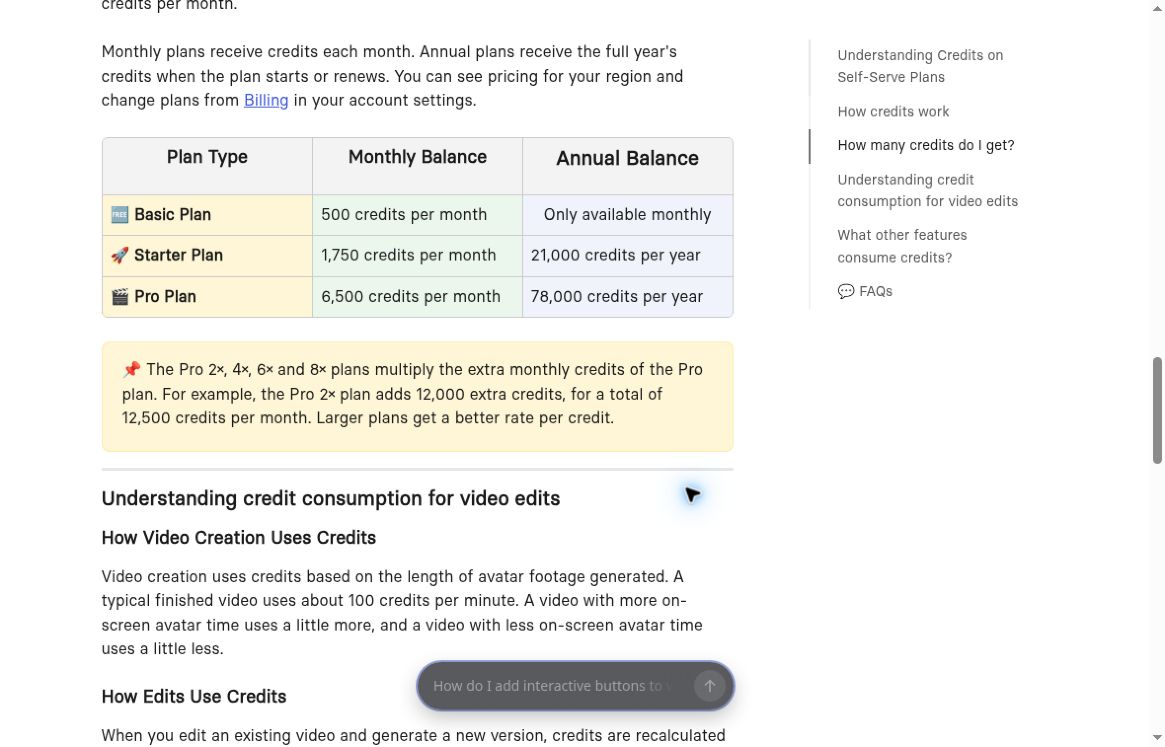
Synthesia official credit guide, captured October 15, 2026. The typical standard-video estimate varies with on-screen avatar time; monthly and annual balances are separate.
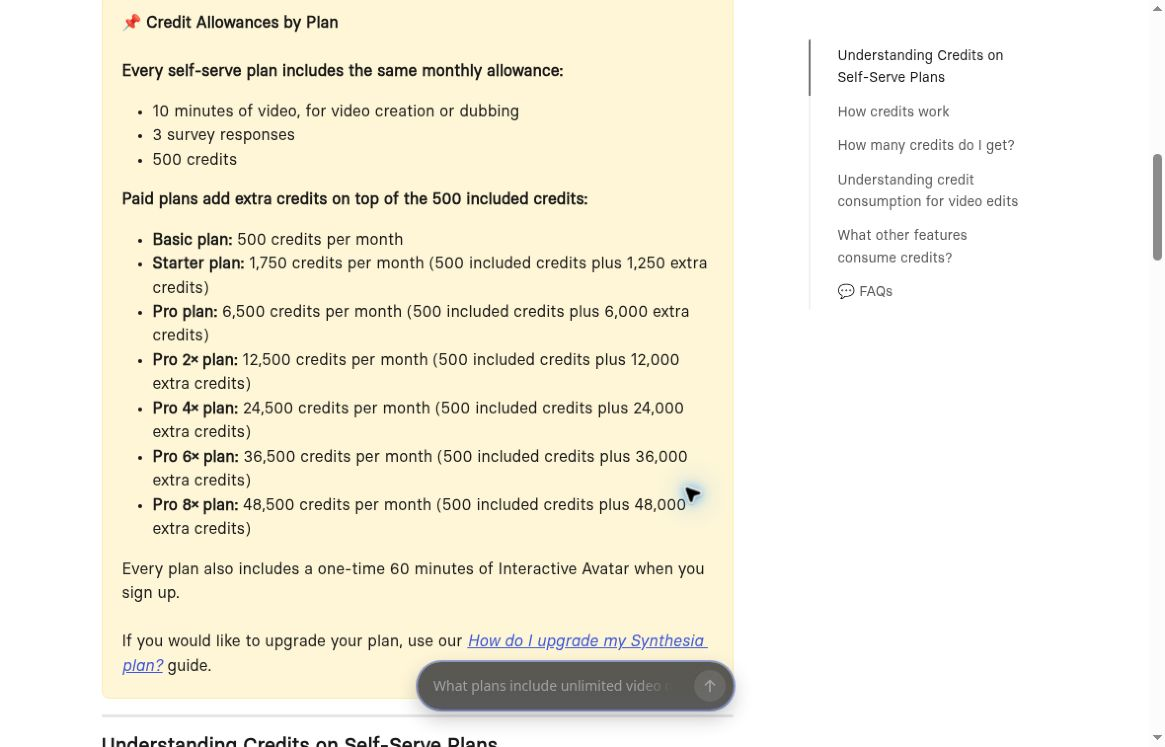
Synthesia official recurring minutes and credit allowances, captured October 15, 2026.
OmniHuman 2.0: a clear metered reference
BytePlus's OmniHuman page advertises $0.07/second, native 720p, and output up to five minutes. That means $4.20 per minute, $12.60 for three minutes, or $21 for five minutes, before additional billed attempts. Compared with OmniHuman 1.5's displayed $0.12/second, 2.0's rate is 41.7% lower.
OmniHuman's image-and-audio performance workflow also advertises prompt-directed movement and multi-person scenes. Those are provider-described capabilities, not findings from a test conducted for this report. Account-specific billing conditions and failed-job treatment should be checked before production.
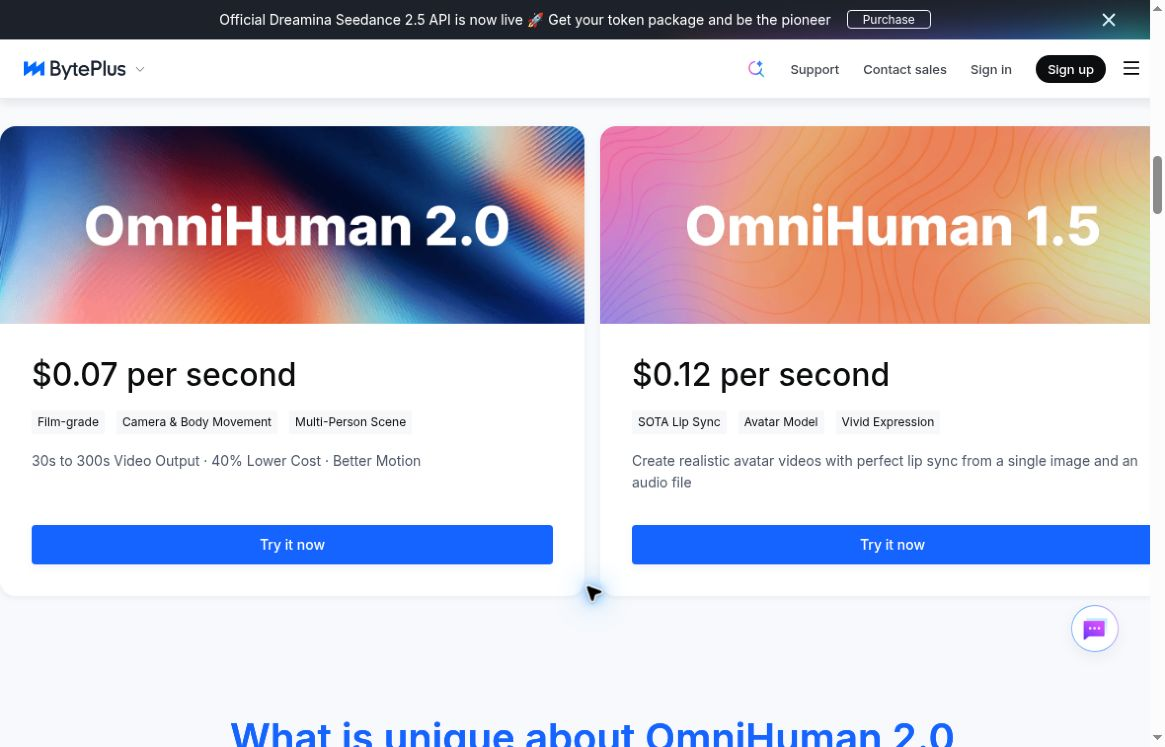
BytePlus official OmniHuman price cards, captured October 15, 2026: 2.0 at $0.07 per second and 1.5 at $0.12.
Low volume changes the answer
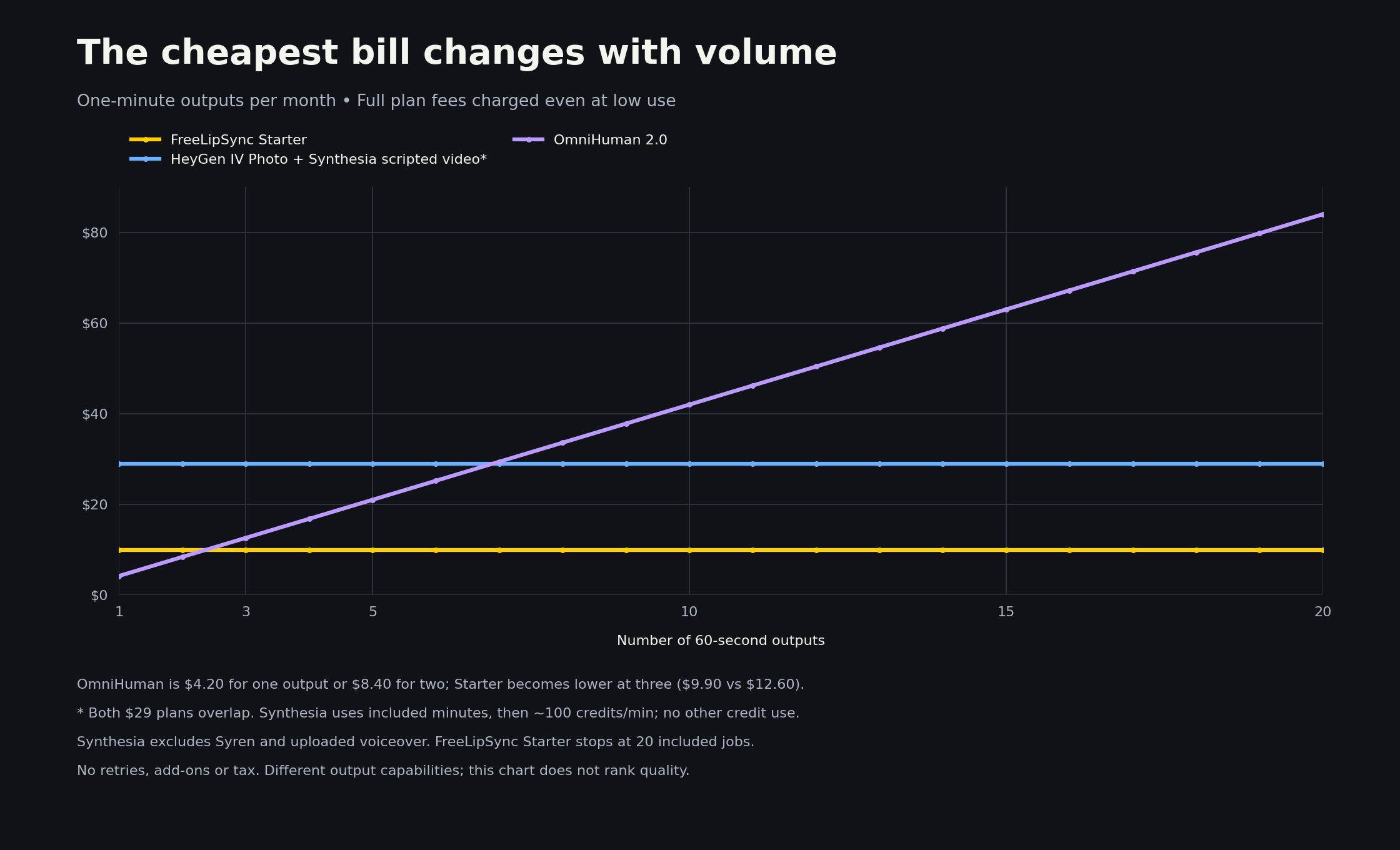
One one-minute OmniHuman generation is $4.20; two are $8.40. Both are below a new $9.90 Starter subscription. At three, OmniHuman totals $12.60 and Starter's fixed fee is lower, assuming standard lip sync meets the brief.
The chart stops Starter at twenty included jobs. HeyGen IV Photo and the Synthesia standard-video estimate share a $29 line across this range. Synthesia assumes its included minutes and credits are reserved for these videos; more expensive assets or other shared-credit features can change the result. All subscriptions are charged in full, even at low use, with no carried balance.
Longer outputs change plan eligibility too. Twenty three-minute standard FreeLipSync outputs still fit Starter at $9.90 only if every included job is used at the maximum. Twenty continuous five-minute outputs require Pro at $69.90; the OmniHuman illustration is $420. Unlimited entitlement does not promise unlimited throughput or a zero cost per usable minute.
Scene-generation context: compare separately
The following API prices are for broader video creation. A “60-second equivalent” is aggregate output across supported clips, not a promise of a continuous one-minute generation.
| API model | Output basis | Published rate | 60-second arithmetic equivalent |
|---|---|---|---|
| Veo 3.1 Lite | 720p, native audio | $0.05/s | $3.00 |
| Veo 3.1 Fast | 720p, native audio | $0.10/s | $6.00 |
| Veo 3.1 Standard | 1080p, native audio | $0.40/s | $24.00 |
| Seedance 2.5 | 480p, no video input, 16:9 reference | About $0.103/s | About $6.18 |
| Seedance 2.5 | 720p, same reference basis | About $0.231/s | About $13.86 |
| Seedance 2.5 | 1080p, same reference basis | About $0.569/s | About $34.14 |
| MiniMax H3 | 768p output | $0.08/s | $4.80 |
| MiniMax H3 | 2K output | $0.13/s | $7.80 |
Google: the Gemini API price list distinguishes Lite, Fast, and Standard. Veo documentation lists four-, six-, or eight-second generations; higher-resolution output requires eight seconds. Do not quote $3 as the price of a single one-minute Lite clip. Required clip sizes can also make actual purchased duration exceed an abstract 60-second budget.
BytePlus: ModelArk pricing bills Seedance by tokens. Its five-second reference examples are $0.514, $1.156, and $2.843 for the three resolutions above; published per-second numbers are rounded estimates. Input video, dimensions, frame rate, and token floors affect the bill. Current Seedance 2.5 documentation supports up to 30-second output and includes 1080p. The launch comparison is historical context, not today's specification ceiling.
MiniMax: the official price list retains H3's $0.08/$0.13 output tiers and separately lists H3-Max at $0.05/s for 480p and $0.08/s for 768p. Reference video and extra images can add charges. Generation documentation caps H3 clips at 15 seconds. Regenerating 768p output at 2K costs $0.05/output second, but original reference inputs may be billed again, so a draft-then-upgrade strategy is not universally cost-neutral.
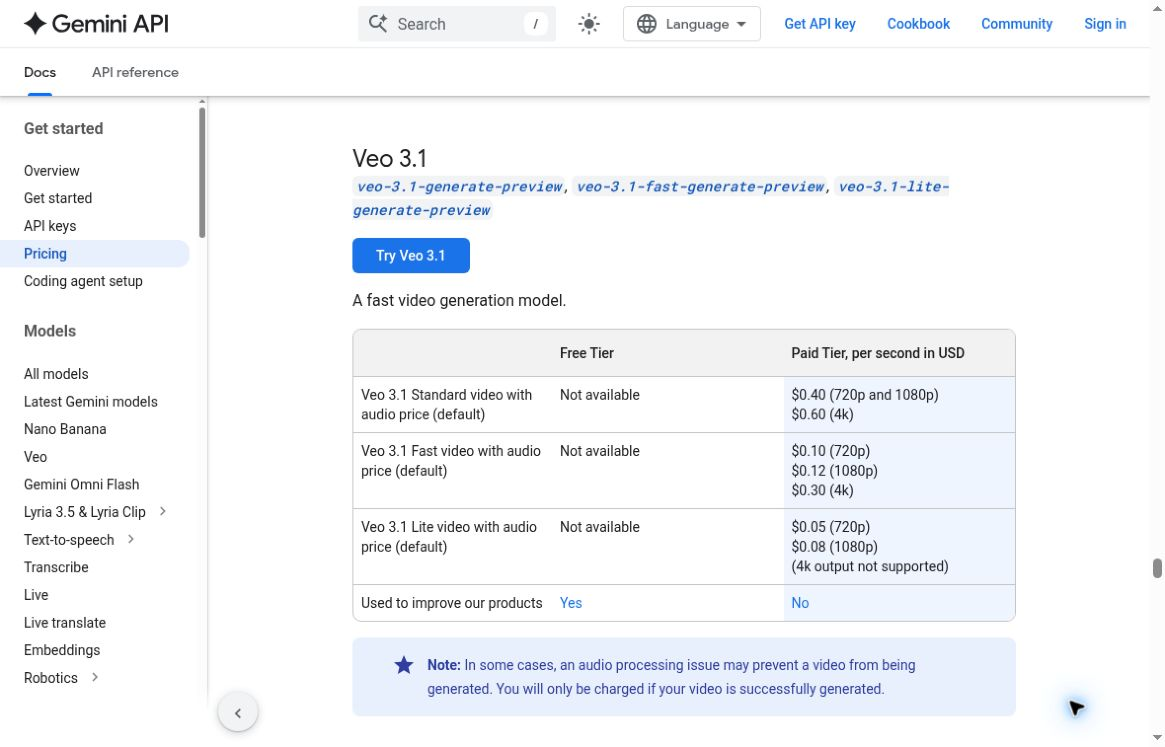
Google official Veo 3.1 API price table, captured October 15, 2026.
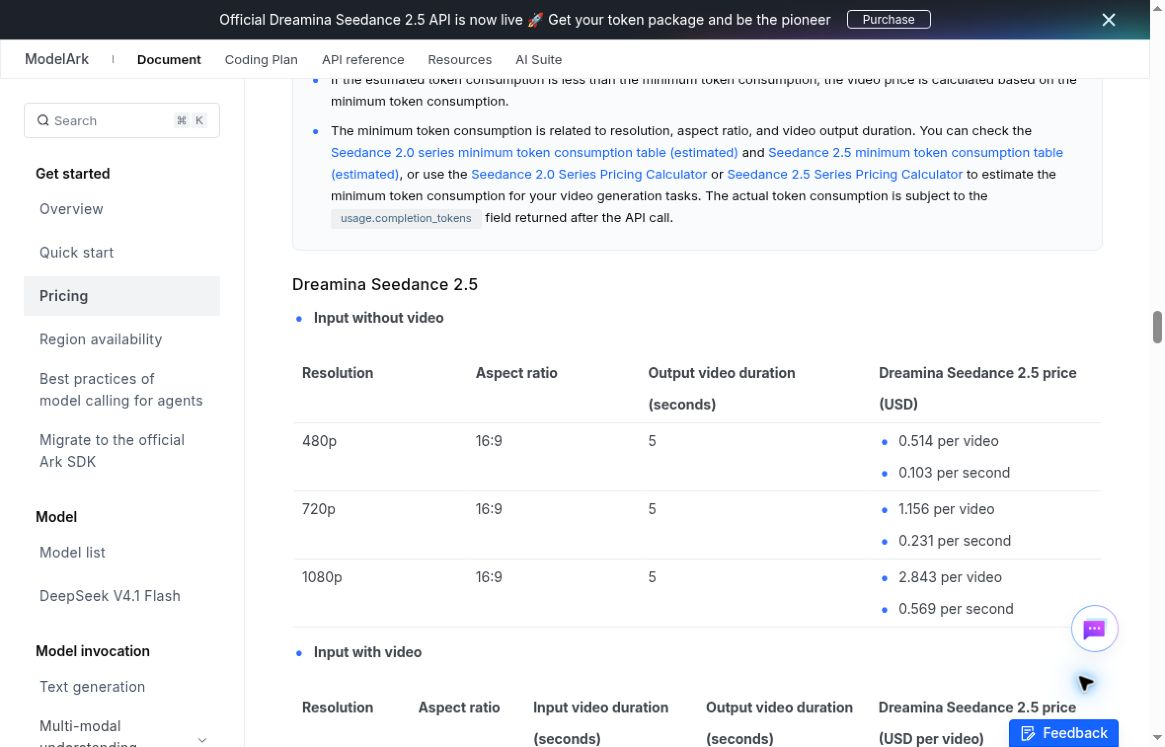
BytePlus official ModelArk Seedance pricing, captured October 15, 2026. Token-based reference examples must be read with their resolution and input assumptions.
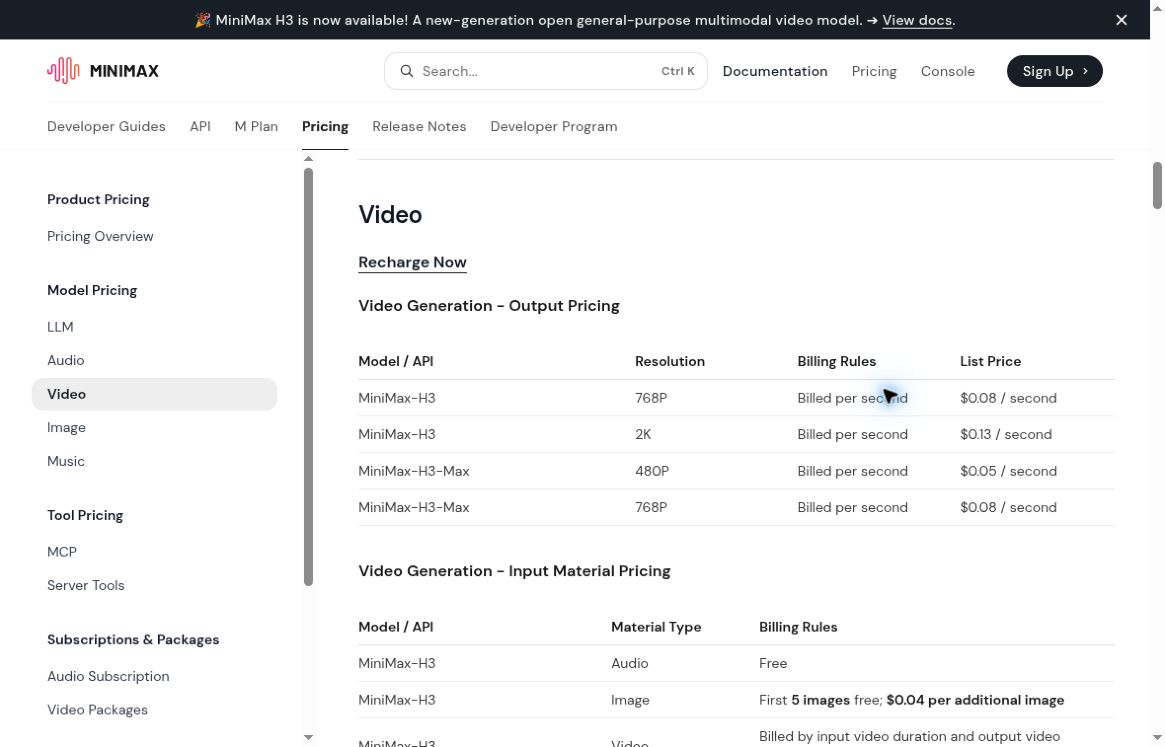
MiniMax official video API pricing, captured October 15, 2026, showing H3 output tiers and the image-reference allowance.
Budget for the take you keep
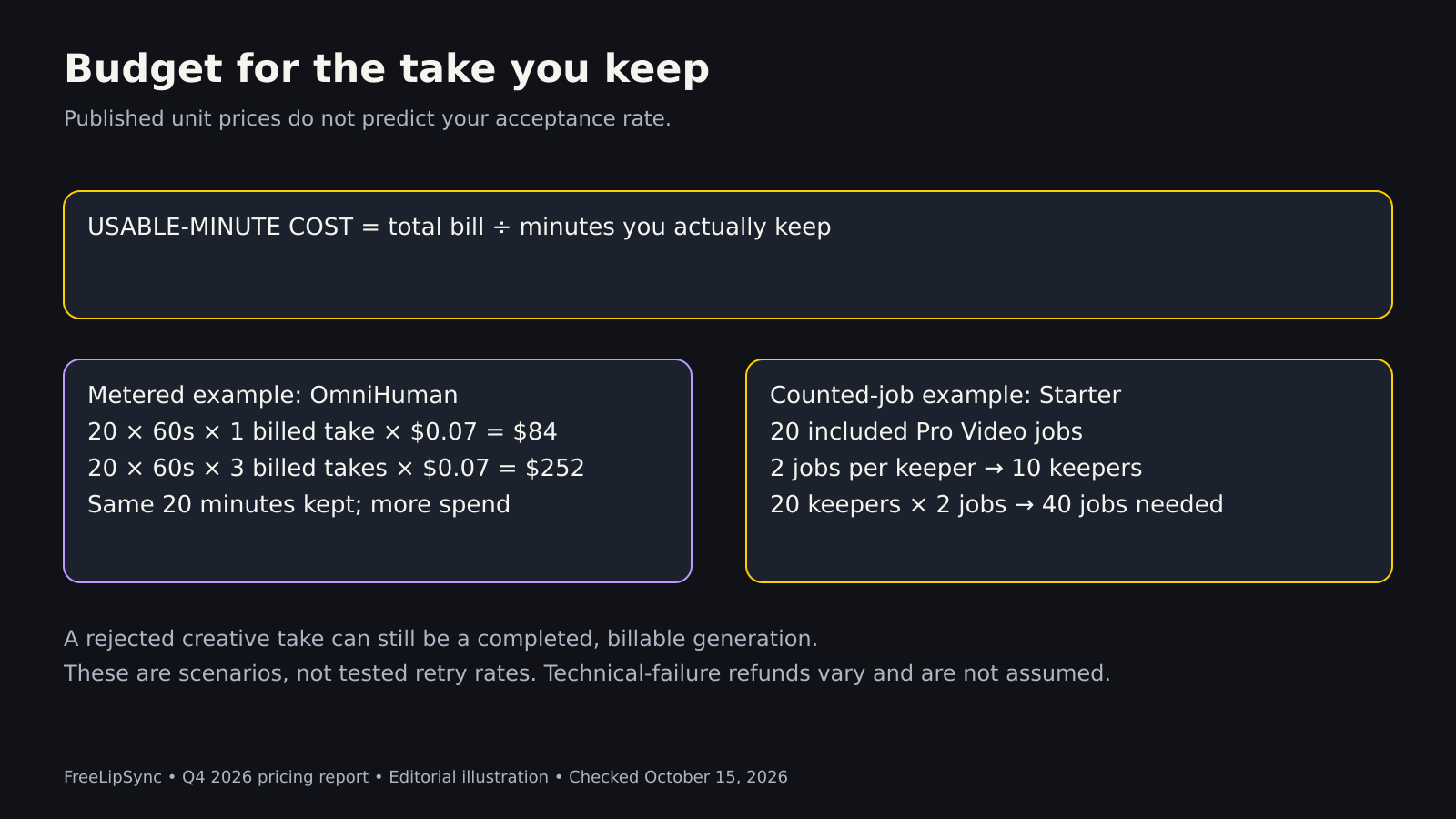
If twenty one-minute OmniHuman keepers each require three billed attempts, the cost becomes $252. If two FreeLipSync Pro jobs are needed for each keeper, Starter's twenty-job allowance supports ten keepers, not twenty. These are planning examples, not measured retry rates.
Before buying, write down the final duration, required export, expected jobs per keeper, rights and watermark needs, credit expiry, and account-specific rate. Then add the entire plan fee, expected extra usage, any input-media charges, and tax where applicable. We have not established a universal failure-refund rule or overage rate across these services; do not assume either free retries or automatic paid expansion.
For regular standard lip sync within its job and duration limits, FreeLipSync Starter offers a particularly straightforward budget: a fixed monthly fee and counted outputs. For occasional image-driven performances, metered billing may be cheaper. For avatar libraries, production controls, or new scenes, choose the workflow that meets the brief, test the result, and only then compare the cost of usable output.