
Anthropic has entered the personal AI assistant race with Claude Duet, announced on October 21, 2026. The new proactive agent works across connected apps, keeps making progress while you are away, and brings decisions back to you. It launches as a research preview through a waitlist for US Claude Pro and Max subscribers, with iOS, Android and web access. Anthropic's announcement.
Following Meta's Muse and OpenAI's dots, Duet makes the competition for a place in your daily life even more intense. For creators, the question is becoming practical: can the assistant in your pocket actually finish a video?
FreeLipSync's MCP connection gives Muse, dots and Claude Duet an AI lip sync video generator they can call from a conversation, with generation starting at $0.50 per minute. Bring a portrait or face video and a voice recording, ask your assistant to make the video, and review the result when it is ready.
Duet, Muse and dots bring the assistant race to your phone
Three launches in roughly six weeks show how quickly the market is moving:
| Personal assistant | Announcement | What the company introduced |
|---|---|---|
| Meta Muse | September 8, 2026 | A personal agent with its own secure cloud computer, available through the Muse app and WhatsApp |
| OpenAI dots | September 29, 2026 | Always-on agents with their own cloud computers, working across connected apps and reachable through ChatGPT, Slack and Teams |
| Claude Duet | October 21, 2026 | A proactive agent that follows connected work, takes on tasks and asks for approval on important actions |
Sources: Meta's Muse announcement, OpenAI's dots announcement, Anthropic's Duet announcement.
These products have different access requirements, but they share a direction: AI is moving from answering a prompt to carrying out work across services. Our reading of the launches is that the next stage of competition will depend heavily on the tools an assistant can use. Writing a campaign brief is useful; returning a finished piece of campaign media takes it further.
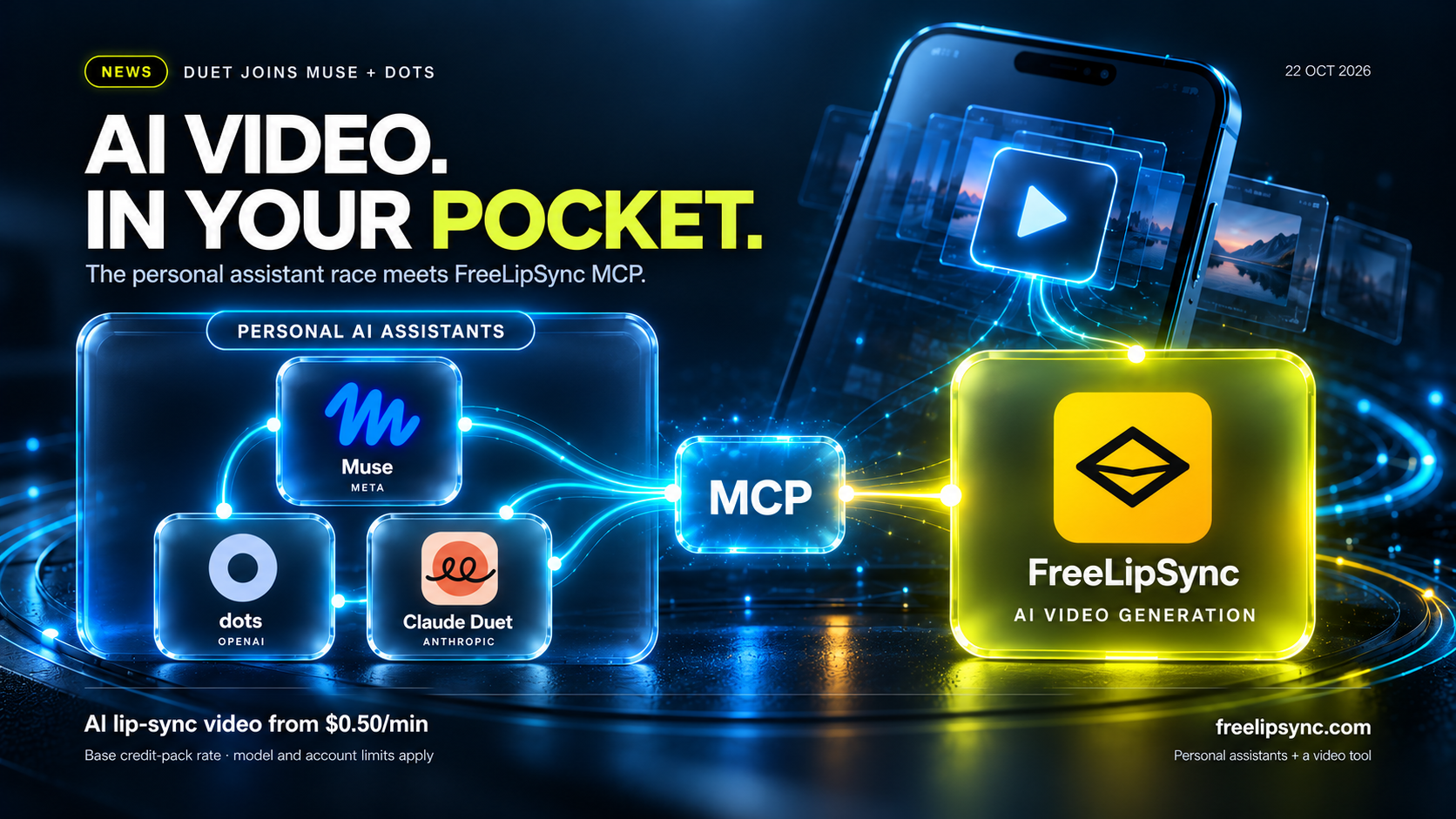
FreeLipSync MCP puts AI lip-sync video generation in your pocket
MCP, short for Model Context Protocol, lets an assistant discover and call tools supplied by another service. FreeLipSync provides the video generation tools; your assistant coordinates the task and brings back the output. Muse, dots and Claude Duet can all connect to FLS MCP.
The practical appeal is a shorter journey from an idea to a video. An assistant can help organize a brief and prepare the assets, request a credit estimate, submit a generation after your approval, check its progress and return a download link. The rendering happens in the cloud, so your phone is the place you give direction and review the result.
For example, a small business owner could send this request:
Use this portrait and my 15-second voice recording to make a talking welcome video for our new store. Use FreeLipSync Fast, show me the credit estimate, and wait for my approval before generating. Send me the download link when it is ready.
A creator could use the same pattern for a character introduction, a product explainer or a localized message using an already-recorded translated voiceover. FLS MCP accepts uploaded audio as the speech input. Script writing and voice recording or synthesis can happen earlier in the assistant's workflow; the ready audio is what drives the FLS generation.
Local files can be supplied through a browser upload session or a client's supported upload flow. A remote MCP connection does not make a path on your phone or laptop available automatically. The MCP setup guide covers both routes.
A low-cost video tool for an always-on assistant
The cost of repeated creative tasks matters when an assistant can keep producing them. FreeLipSync's API and MCP share the same credit wallet and model rates, with no separate MCP connection fee.
| FLS generation workflow | Credits per second | Price per minute at the base credit pack |
|---|---|---|
| Existing face video + audio | 1 | $0.50 |
| Talking photo — Fast | 1 | $0.50 |
| Talking photo — Max | 2 | $1.00 |
| Super / Motion Control | 3 | $1.50 |
| Music Video | 3 | $1.50 |
The base pack is $10 for 1,200 credits. Larger packs offer $50 for 6,500 credits or $100 for 14,000 credits, reducing the effective cost per minute. Each registered account also receives 30 one-time welcome credits when its API wallet is first initialized. At the Fast rate, that is enough for two 15-second generations.
That makes FLS an affordable way to add video creation to a personal assistant: a 15-second Fast generation uses 15 credits, equivalent to $0.125 at the base pack rate. Current model rates and wallet rules are documented in the API guide.
Billing uses the server-verified driving audio duration, rounded up to the next second with a five-second minimum. Accepted jobs reserve credits and cannot be cancelled; confirmed processing failures return the reserved credits. API/MCP credits are separate from website membership benefits. Account and model duration limits still apply, and Super / Motion Control requires an eligible paid membership.
Connect FLS to your personal AI assistant
Start in the FreeLipSync Agent console. Sign in, check your welcome credits and connect your assistant to the remote MCP endpoint:
https://freelipsync.com/mcp
Use the connection method supported by your assistant: browser-based OAuth authorization, or an API key in a client that supports Bearer headers. The FreeLipSync MCP guide provides configuration details, upload options and tool verification. Begin with a short recording and ask for an estimate before generating.
Duet's arrival raises the stakes for Muse, dots and the wider assistant market. For creators and small businesses, the useful outcome is more work completed from the conversation already in their pocket. With FLS MCP connected, that work can now include a talking video.